
#37
On Jake Westbrook, Cody Allen...and Travis Bazzana

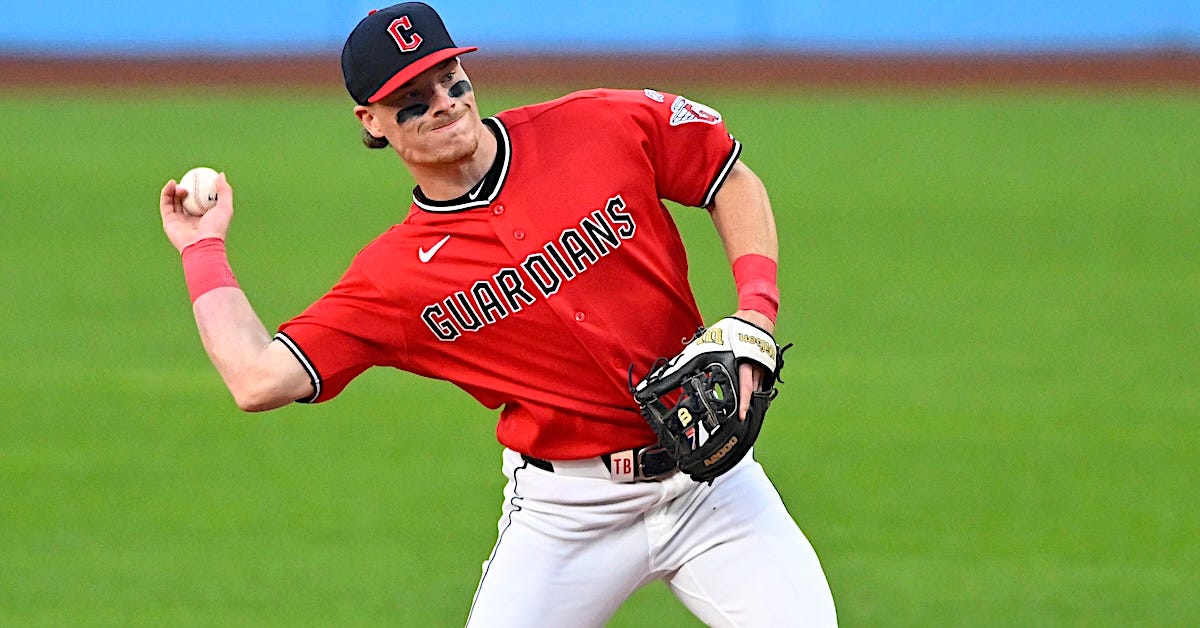
Until the Guardians drafted Travis Bazzana in 2024, they had never picked first in the MLB Draft. By then, they were one of only seven MLB teams never to have held the No. 1 overall pick, along with the Red Sox, Reds, Rockies, Dodgers, Giants, Cardinals and Blue Jays. It never felt, at least to me, like the organization’s fate rested on Bazzana alone. The history of the No. 1 pick has changed, and the Guards took their time with Travis. While some players picked later in the draft have debuted ahead of him and already flourished (ahem: Nick Kurtz, 2025 AL Rookie of the Year), Baz so far looks worth the wait. Travis hit his first career home run Friday, so in honor of that achievement I wanted to write a little about Baz, and about #37.
Cleveland Players Who Wore 37: 36
If you had asked me before writing this whether 37 was a popular number in Cleveland history, I would have said no. I was not exactly wrong, but I underestimated how good some of the players who wore it were. Two Hall of Famers wore the number: Larry Doby and Dennis Eckersley, although Doby is much more closely associated with 14. There was also one near-Hall of Famer in Tommy John. More recently, Trevor Stephan, who posted a dominant 2022 season capped by a superb ALDS against his former club, the Yankees, wore 37. More famously, longtime closer Cody Allen wore it too, and he still holds the untainted club record for saves.
I loved Cody Allen. After years of nerve-racking ninth innings from 2006 to 2012, Allen was a breath of fresh air. After Bob Wickman got traded, and Wickman himself loved the tightrope act, Cleveland cycled through Fausto Carmona, Joe Borowski, Jensen Lewis, Masahide Kobayashi, Kerry Wood, Chris Perez, and then finally landed a dynamite closer who let you breathe for an inning instead of reaching for heart medicine, or more likely a stiff drink. For four wonderful seasons, Allen was as lockdown as any closer in the AL. From 2014 through 2017, Cody Allen ranked fifth among AL relievers in fWAR and third in saves. Not the best reliever in the league, but a darned good one. The wheels fell off in 2018, like much else in that bullpen, and he was out of the majors a year later.
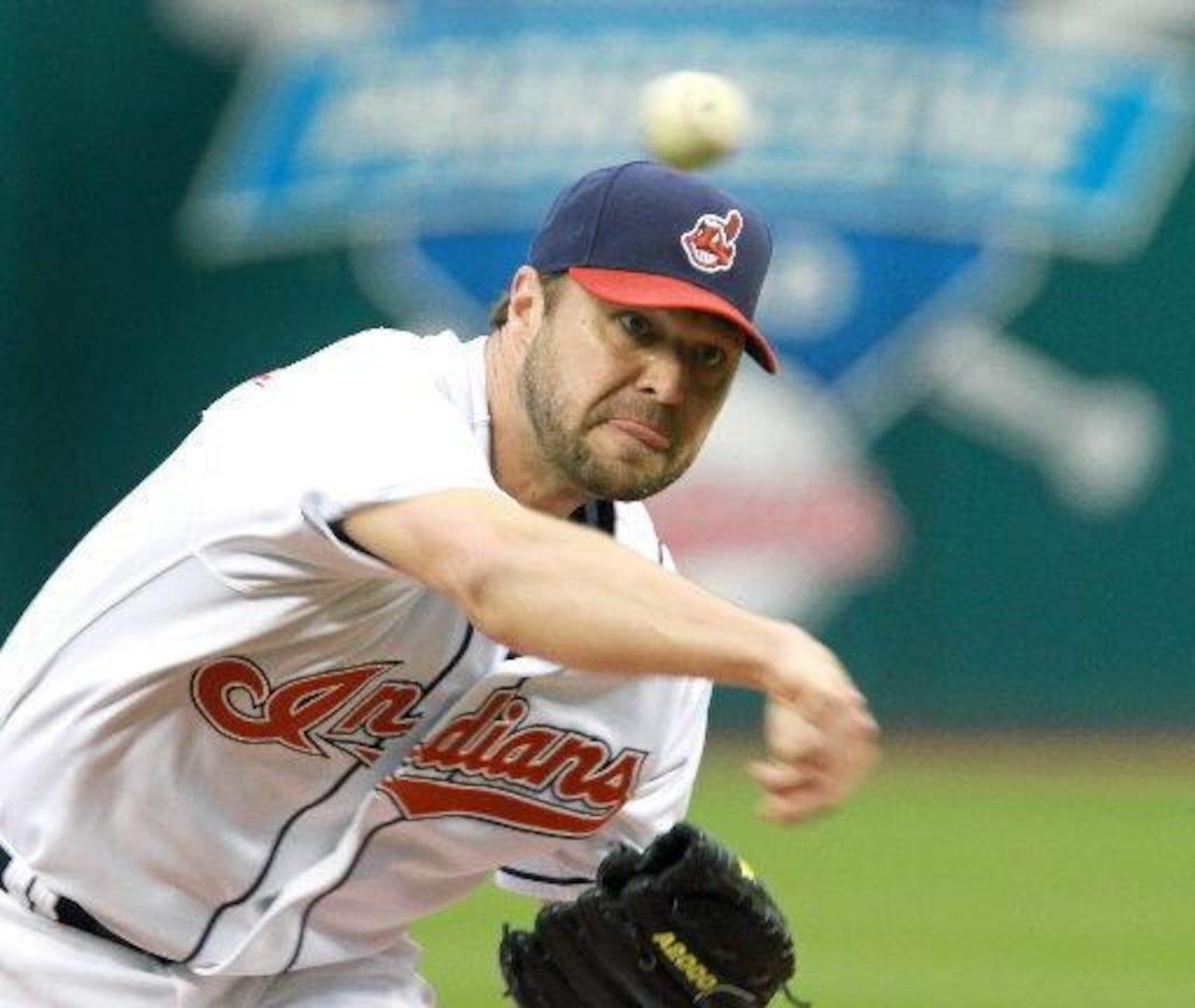
Player Who Wore 37 the Longest: Jake Westbrook (9 seasons)
I have fond memories of Jake Westbrook. Never truly the ace, but always dependable. Picked up from the Yankees in the David Justice trade, he became one of the first of Cleveland’s stereotypical reclamation projects. Jake struggled in New York but found a way to flourish in Cleveland. It would be unfair to say Westbrook was ever anything more than reliable. He made an All-Star team in 2004, when he led the AL in complete games, though he did not appear in the game.
At his best, he was a strong innings-eater. In 2004 he posted a 3.38ERA in 215.2 innings. This was back when people cared less about strikeout-to-walk ratios and fastball velocity, and more about pitchability. Westbrook, whatever his other faults, usually kept his team in the game. That year he pitched at least five innings in 31 of his 33 outings, imagine that now. He pitched at least six innings 26 times. As a sinkerballer, he did not look like someone who should overtax his arm, and managers certainly treated him that way. He threw 94 pitches or more 26 times in 2004. Westbrook usually did not strike out many, or walk many, and let the defense do the work.
For three years, that formula worked. From 2004 through 2007, he was Cleveland’s most reliable pitcher besides C.C. Sabathia. He tossed more than 200 innings three times, averaged 197.3 innings per season in that stretch, posted a 4.07 ERA with a 108 ERA+, and made some really important starts when the Indians finally returned to the playoffs in 2007.
That 2007 postseason sticks out the most for me with Westbrook. In a postseason where aces C.C. Sabathia and Fausto Carmona struggled, Westbrook and Paul Byrd stepped up. Jake’s first start was a bit of a doozy against the Yankees, but against the Red Sox he was rock solid. Game 3 might have been the high point of the season to that point. Coming off the fireworks show in Game 2, Cleveland returned home and Westbrook was exactly what the team needed. He got touched up some, but he scattered seven hits and three walks over 623 innings, with three double plays helping him escape trouble. He left in the seventh inning with a firm lead.
Then, in the most important game of the year, Westbrook showed up again. If anything, you could argue he was better, striking out five and walking only one, while again scattering nine hits, thanks in part to another three double plays, and allowing three runs. It is not Westbrook’s fault the offense could not get going. We all remember Joel Skinner holding up Kenny Lofton and Casey Blake grounding into a double play. In hindsight, that mattered a little less than we like to remember. Rafael Betancourt got torched the next inning, and the pitching staff completely unraveled.
But when the Indians called, Jake Westbrook answered. He was a reliable pitcher here for several years. His health declined, he missed much of 2008 and all of 2009, and in 2010 he made the Opening Day start, basically by default, just as he had in 2004, and then got traded to St. Louis midseason, helping bring back Corey Kluber.
Westbrook was not a star, and not the most memorable player to wear a Cleveland uniform from 2001 to 2010. But he was a cog, a player the team needed in order to succeed, even in big moments. He is the kind of pitcher Cleveland fans should remember from time to time and smile about.
Travis Bazzana and Expectations
It feels too early to write that much about Bazzana, I will have to write more about him in a few years, but he arrived with about as much hype as any Cleveland prospect I can remember. In my time as a fan, the prospects who debuted with something close to this level of hype were, in chronological order:
2009: Matt LaPorta. That did not work out. LaPorta was the “top prospect” from the Sabathia trade, and he went nowhere. I cannot recall a single big moment from his career.
2010: Carlos Santana. This might be revisionist, but I remember being very excited for Santana’s debut. He felt like the natural heir to Victor Martinez, who had just been traded. He filled a hole in the heart of Cleveland fandom, and he paid off in spades.
2015: Francisco Lindor. Arguably the biggest Cleveland prospect in decades, and still probably the biggest since. He is on his way to the Hall of Fame.
2025: Chase DeLauter. He debuted in the postseason, which was unusually aggressive, and it is too early to say for sure, but he sure is hitting to start the season.
2026: Travis Bazzana…
As of this writing, Bazzana’s start has been weird. He entered Friday, May 8, hitting .192., which is bad. It is rare that batting average tells you enough, but in this case it tells you plenty. That is not the full story, though, because weirdly he also carried a .382 on-base percentage. Only Chase DeLauter had a higher OBP on the team. Bazzana had walked seven times in only eight games, more than 20% of the time. While he was not getting rewarded for that patience with many hits, he certainly did not look overmatched.
I have no clue how Bazzana’s season will play out, let alone his career. But it will be fun to watch. And while it would be disappointing if Bazzana does not reach the heights of Lindor or José Ramírez, we should keep some perspective. Even if Baz only reaches the level of a Jake Westbrook, a player who starts games as important as Games 3 and 7 of the 2007 ALCS and performs that well, that is still a pretty good pick.
-BenjaminJ